The spinal disc acts as a strong elastic pivot for each joint segment of the spine, providing stability and allowing a relatively wide range of motion in all directions in the lower back and neck. When a disc starts to lose its strength and pliability, however, it can cause a range of painful and potentially debilitating symptoms.
This article cuts through all of the noise and reviews the most salient points to know about spinal disc problems.
What is a Spinal Disc
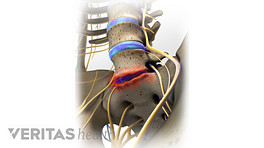
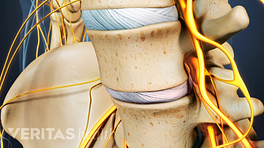
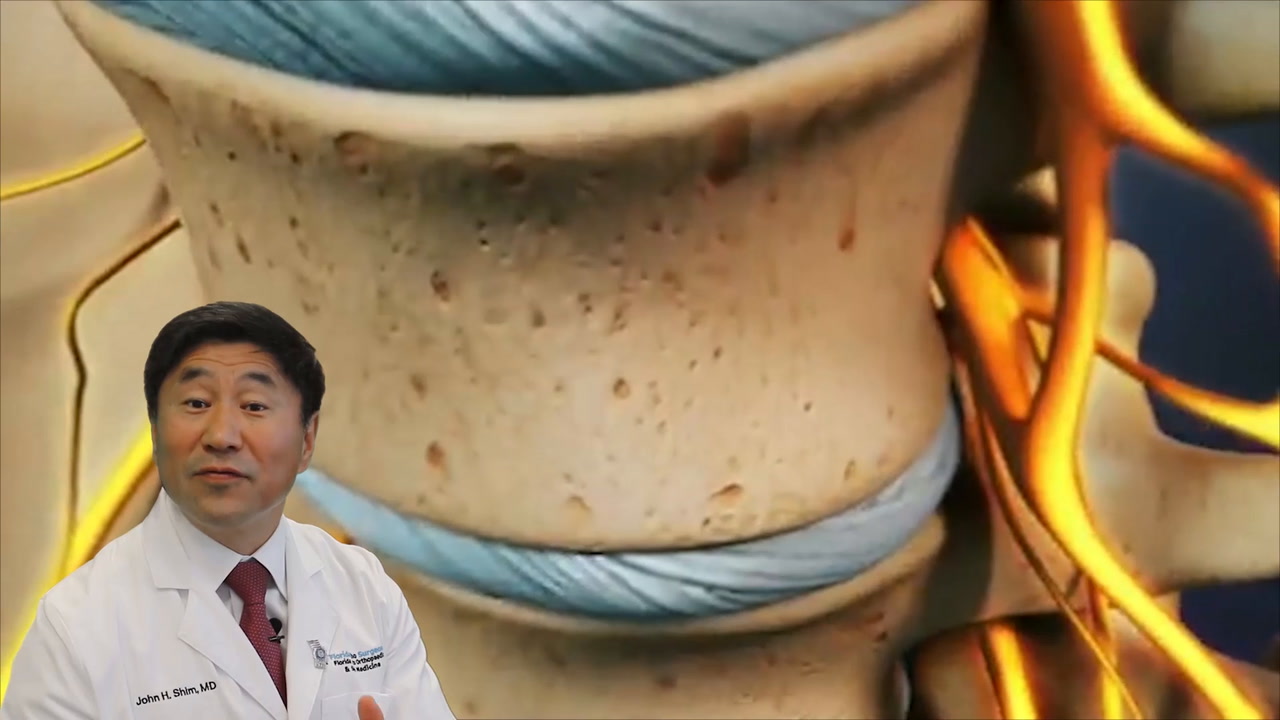
Spinal discs are round in diameter and flat on the top and bottom, and are attached securely to the vertebrae above and below them. The discs are somewhat pliant, providing shock absorption for the spine.
See Spinal Discs
Because of the many stresses sustained by the lower back and neck, and changes due to aging, the disc is prone to injury.
- When the disc breaks down in the lower spine, it can lead to can lead to lower back pain, leg pain and other symptoms such as numbness and weakness.
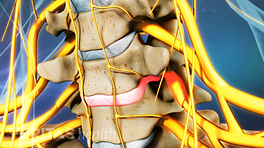
- In the neck, a problem with a disc can lead to pain and symptoms in the neck, shoulder, arm and possibly into the hand.
See Cervical Discs
Spinal disc problems are widely misunderstood for a number of reasons: medical professionals do not always agree on causes of pain related to the spinal disc, and patients understandably have a hard time understanding this complex – and often not well explained – medical topic.
See Pain Generated by the Spinal Disc
Confusion is also created because many terms are used somewhat interchangeably to describe a spinal disc problem, such as a pinched nerve, degenerated disc, slipped disc, herniated disc, bulging disc, and so on.
See What's a Herniated Disc, Pinched Nerve, Bulging Disc...?
In This Article:
- All About Spinal Disc Problems
- 3 Insights for Patients with Disc Problems
- Video: Can Herniated Discs Heal on Their Own?
Disc Pain vs. Nerve Root Pain
While there are dozens of terms used to describe disc problems, there really are only two main categories of disc problems:
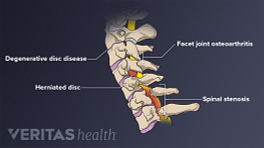
Degenerative Disc Disease
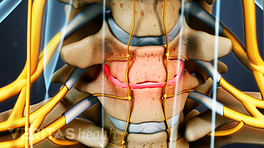
If the pain originates within the disc itself, the patient will experience either axial or referred pain. This condition can occur as part of the aging process in which the discs in the spine start to dry out, thereby losing some of their flexibility and shock absorption. As part of this process, the inner portion of the disc shrinks, providing less cushioning between the boney vertebrae in the spine, and the outer part of the disc can suffer small tears, all of which can cause pain.
See Common Symptoms of Degenerative Disc Disease
The exact cause of pain generated by the disc is still controversial, but there can be both a biochemical reaction and a biomechanical component.
See Causes of Degenerative Disc Disease Pain
On this site, the term consistently used to describe this type of pain is "degenerative disc disease".
Herniated Disc
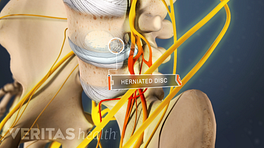
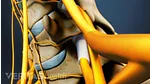
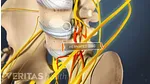
If a disc problem is causing nerve root pain, or pain that travels along one of the nerves that exits the spine, it is called radicular pain. This can happen if the inner material of the disc, the soft nucleus, leaks out of the disc (or “herniates”) and touches the nerve root. The material within the disc is highly inflammatory, and any contact with a nerve can cause pain.
See Spinal Cord and Spinal Nerve Roots
The pain and other symptoms, such as numbness, tingling or weakness, typically travels along the path of the nerve, so that a disc that herniates in the lower part of the spine causes pain along the sciatic nerve through the back of the leg, and a disc that herniates in the cervical spine causes pain that radiates through the arm.
See Cervical Herniated Disc Symptoms and Treatment Options
On this site, the term consistently used to describe this type of pain is a "herniated disc".
Regardless of what the disc problem is called – a slipped disc, bulging disc, degenerated disc, etc. – it is most important for the patient to understand if the pain is being caused within the disc itself, or if it is pain along the nerve root.
An accurate diagnosis of the cause of the patient's pain is needed to determine the appropriate treatment options. For a more detailed discussion, see Diagnosing Disc Problems.