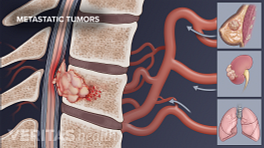
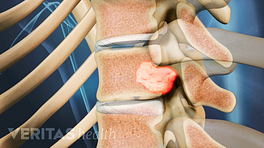
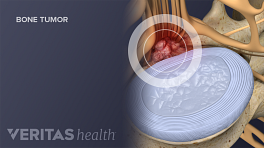
There are 2 general types of spinal tumors that can cause pain: primary tumors and secondary (metastatic) tumors.
- Primary spinal tumors originate in the spinal column, such as by growing in the bones, discs, nerves, or other elements within the spine. Primary spinal tumors are usually noncancerous (benign) and occur in younger people. Hemangiomas are among the most common benign primary spinal tumors. 1 Spinal Tumors. American Association of Neurological Surgeons. https://www.aans.org/Patients/Neurosurgical-Conditions-and-Treatments/Spinal-Tumors. Visited October 25, 2019. , 2 Ciftdemir M, Kaya M, Selcuk E, Yalniz E. Spinal tumors of the spine. World J Orthop. 2016; 7(2): 109-116. doi: 10.5312/wjo.v7.i2.109. Osteosarcomas and multiple myeloma are two of the more common primary spinal tumors that are cancerous (malignant).
- Secondary spinal tumors (metastatic tumors) are tumors that have spread to the spine from a cancer that has started elsewhere in the body. These tumors are the most common type in the spine and are cancerous (have the potential to spread further and are typically fast-growing). Cancerous cells from the lung, breast, and prostate are most likely to spread and become lodged in the spine.
It is estimated that about 90% of diagnosed spinal tumors are metastatic. 3 Ziu E, Mesfin FB. Cancer, Spinal Metastasis. [Updated 2019 Apr 23]. In: StatPearls [Internet]. Treasure Island (FL): StatPearls Publishing; 2019 Jan-. Available from: https://www.ncbi.nlm.nih.gov/books/NBK441950/.
In This Article:
Spinal Tumors by Location
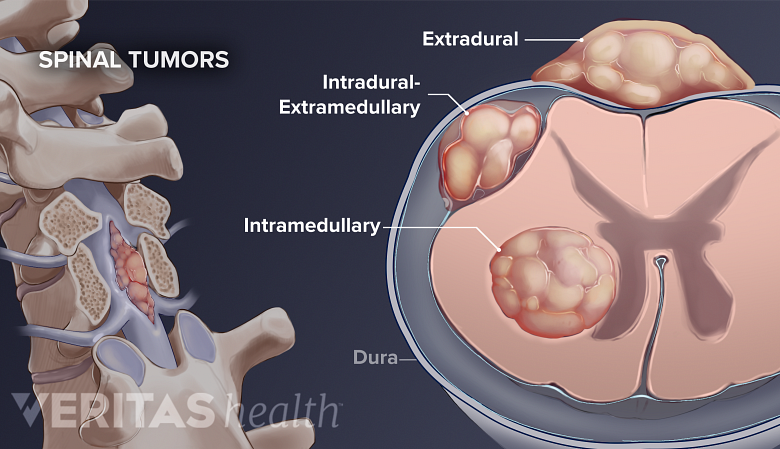
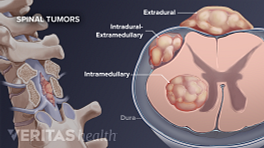
Spinal tumors are categorized as intramedullary, extramedullary, and extradural.
Spinal tumors can also be classified based on their location inside or outside the spinal cord.
Extradural Tumor
A spinal tumor that forms outside the spinal cord’s outermost protective layer (dura) is known as an extradural tumor (epidural tumor). These tumors are commonly metastatic and have spread from cancer located in another part of the body.
Intradural-Extramedullary Tumor
An intradural-extramedullary (inside the dura) tumor grows under the outermost layer (dura) that covers the spinal cord but outside of the spinal cord. Usually these tumors are benign and slow-growing. They can cause symptoms of pain and weakness.
Common intradural-extramedullary spinal tumors are:
- Meningiomas that occur in the membranes surrounding the spinal cord and are more common in women who are middle age or older. 4 Sun T, Plutynski A, Ward S, Rubin JB. Cell Mol Life Sci. 2015; 72(17):3323-42.
- Nerve sheath tumors (schwannomas and neurofibromas) that arise from the nerve roots that come off the spinal cord. These tumors may be present for many years before causing neurological symptoms.
Intramedullary Tumor
An intramedullary tumor grows inside the spinal cord and typically arises from the cells that provide physical support and insulation for the nervous system (glial cells). These tumors occur most often in the cervical spine (neck). 5 Tobin MK, Geraghty JR, Engelhard HH, Linninger AA, Mehta AI. Intramedullary spinal cord tumors: a review of current and future treatment strategies. Neurosurg Focus. 2015; 39(2):E14. doi: https://doi.org/10.3171/2015.5.FOCUS15158. They tend to be benign, and surgery to remove the tumor may be difficult. The two most common types of intramedullary tumors are astrocytomas and ependymomas.
Collecting as much information about the spinal tumor’s type and location, as well as the symptoms it is causing, is critical for reaching an accurate diagnosis.
- 1 Spinal Tumors. American Association of Neurological Surgeons. https://www.aans.org/Patients/Neurosurgical-Conditions-and-Treatments/Spinal-Tumors. Visited October 25, 2019.
- 2 Ciftdemir M, Kaya M, Selcuk E, Yalniz E. Spinal tumors of the spine. World J Orthop. 2016; 7(2): 109-116. doi: 10.5312/wjo.v7.i2.109.
- 3 Ziu E, Mesfin FB. Cancer, Spinal Metastasis. [Updated 2019 Apr 23]. In: StatPearls [Internet]. Treasure Island (FL): StatPearls Publishing; 2019 Jan-. Available from: https://www.ncbi.nlm.nih.gov/books/NBK441950/.
- 4 Sun T, Plutynski A, Ward S, Rubin JB. Cell Mol Life Sci. 2015; 72(17):3323-42.
- 5 Tobin MK, Geraghty JR, Engelhard HH, Linninger AA, Mehta AI. Intramedullary spinal cord tumors: a review of current and future treatment strategies. Neurosurg Focus. 2015; 39(2):E14. doi: https://doi.org/10.3171/2015.5.FOCUS15158.