
Subscribe to our newsletter and get your FREE
Cervical Spine Symptoms Checklist.
Whiplash occurs when the neck and head are suddenly forced backward and then forward, putting the cervical spine through lightning-quick motions and extreme stresses.
Most cases of whiplash are caused by car accidents where the person has been rear-ended. Other potential whiplash causes, while comparatively rare, can include assault, bungee jumping, rollercoaster, football, falls while skiing or during equestrian events, and other high-impact activities where extreme acceleration-deceleration forces might be applied to the cervical spine.
Whiplash is medically known as cervical acceleration-deceleration (CAD) syndrome.
In This Article:
Whiplash Symptoms Can Be Extensive
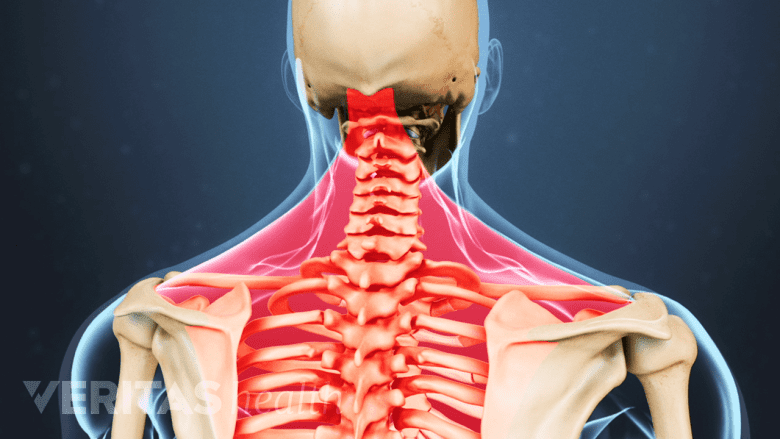
The common symptom of whiplash is neck pain, ranging from neck stiffness to reduced range of motion.
The most common symptom of whiplash is neck pain, which can range anywhere from mild to pins-and-needles tingling to excruciating. Other symptoms can include neck stiffness or reduced range of motion, neck instability, shoulder and/or upper back pain, or headache. There could also be tingling, weakness, or numbness that radiates into the shoulder and/or down the arm.
See How to Treat Stiff Neck After Direct Trauma
Whiplash symptoms can be numerous, complicated, long-lasting, and hard to diagnose, which is why they are commonly known as whiplash-associated disorders. Concurrent injuries may also be symptomatic, such as a stinger, concussion, radiculopathy (pinched nerve with radiating pain into the arm), or shoulder injury.
Watch Cervical Radiculopathy Video
If a whiplash injury causes a person to have reduced physical or mental abilities—even if they are just temporary—it can result in increased social isolation.
advertisement
The Biomechanics of Whiplash

As the neck rapidly extends backward, the soft tissues and muscles of the neck are prone to injury.
The process of a whiplash injury sustained in a car accident can vary depending on many factors, including the angle of the collision. Usually the collision happens from behind, resulting in a whiplash injury that can be considered to occur in five general phases:
- Car gets hit from behind, which causes the seat to push against the back. The spine then gets loaded with forces that compress the cervical spine upward against the head.
- The torso (in contact with the seat) continues to accelerate forward but the head (not in contact with the seat yet) does not. As a result, the cervical spine’s natural C-shape (lordosis curve) temporarily becomes an unnatural S-shape. The abnormal compression and shearing forces can potentially damage intervertebral discs, facet joints, and other neck structures.
- Person’s head slams backward into the accelerating seat. Soft tissues at the front of the neck are likely to be injured here as the neck rapidly extends backward.
- The head bounces off the seat and now accelerates forward.
- The seatbelt restrains the body (likely preventing a much worse injury) and the neck rapidly flexes as the head whips forward. Soft tissues at the back of the neck are likely to be injured here.
While the severity of the car crash usually correlates to the severity of the whiplash injury, there are exceptions. Sometimes a sturdy car does not crunch up and thus shows no significant outside damage, but the forces that were not absorbed by the car exterior were instead transferred through the seat and thus caused worse whiplash. Also, whiplash injuries have been recorded in incidents where the speed at impact was less than 10 miles per hour. 1 Bogduk N, Yoganandan N. Biomechanics of the cervical spine Part 3: minor injuries. Clinical Biomechanics. 2001; 16(4) 267-275.
The Course of Whiplash Pain
Most people who sustain a whiplash injury will completely recover within 3 months, but some studies show a significant number will have chronic pain or other symptoms that linger longer – sometimes for years.
Factors that increase risk for a longer whiplash recovery include:
- Severe pain at time of injury
- Post-traumatic stress disorder
- Older age
- Female gender
Whiplash symptoms may present at the time of the whiplash injury, or there could be a delay of up to 24 hours before they appear.
advertisement
When Whiplash Is Serious
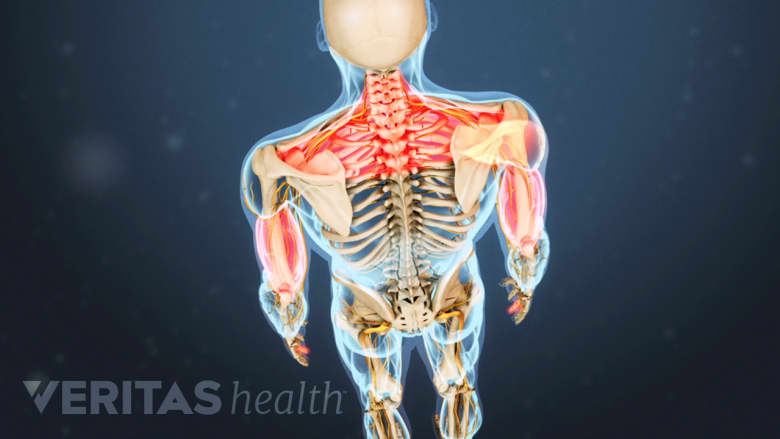
Pain, numbness, and weakness radiating to the shoulder and arms may require immediate medical attention.
Anyone who experiences physical symptoms after a motor vehicle accident is advised to see a doctor for a checkup. However, any of the following signs require immediate medical attention:
- Severe pain
- Neck instability
- Pain, tingling, numbness, and/or weakness that radiates into the shoulder, arm, and/or hand
- Problems with balance or coordination
- Mental health issues, such as increased irritability, depression, trouble sleeping, reduced concentration, or other drastic changes in behavior
Seeking treatment early for whiplash is recommended. Delaying treatment can reduce its effectiveness in some cases.
- 1 Bogduk N, Yoganandan N. Biomechanics of the cervical spine Part 3: minor injuries. Clinical Biomechanics. 2001; 16(4) 267-275.

advertisement