More Search Tools: Doctors Videos
Spine Anatomy

All About Spinal Disc Problems

By: Peter F. Ullrich, Jr., MD
disc herniation
Fig 1: Disc herniation
(larger view)

Spinal disc problems are widely misunderstood for a number of reasons: medical professionals do not always agree on causes of pain related to the spinal disc, and patients have a hard time understanding this complex – and often not well explained – medical topic. In addition, spinal disc problems are often misunderstood because of the plethora of terms used to describe disc-related pain, such as a pinched nerve, degenerated disc, slipped disc, herniated disc, bulging disc, and so on.

This article cuts through all of the noise and reviews the most salient points that patients need to know about spinal disc problems.

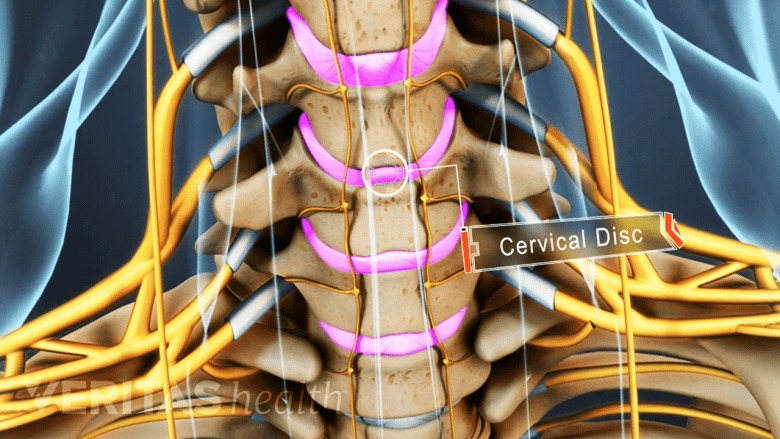
Spinal discs are round in diameter and flat on the top and bottom, and are attached securely to the vertebrae above and below them. The discs are somewhat pliant, providing shock absorption for the spine. Because of the many stresses sustained by the spine and changes due to aging, the disc is somewhat prone to injury, which in turn can lead to pain and other symptoms. For more details, see Spinal Disc Anatomy.

First, Understand the Category of Pain: Disc Pain or Nerve Root Pain

While there are dozens of terms used to describe disc problems, there really are only two main categories of disc problems.

Article continues below
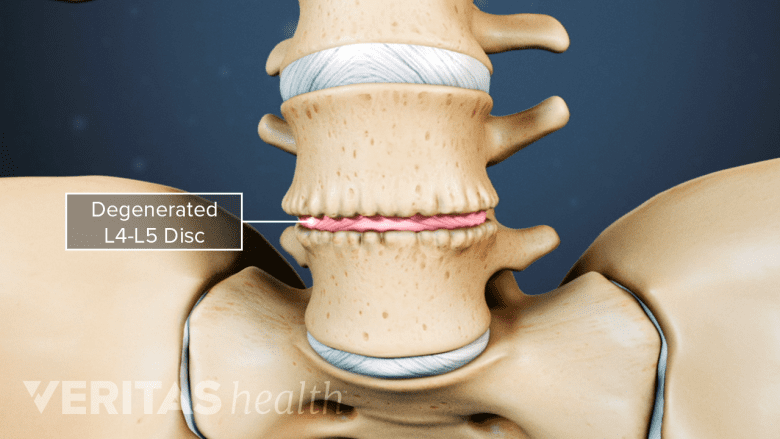
  1. If the disc itself is the source of the pain, the patient will experience either axial or referred pain. This condition can occur as part of the aging process in which the discs in the spine start to dry out, thereby losing some of their flexibility and shock absorption. As part of this process, the inner portion of the disc shrinks, providing less cushioning between the boney vertebrae in the spine, and the outer part of the disc can suffer small tears, all of which can cause pain. The exact cause of pain generated by the disc is still controversial, but there can be both a biochemical (inflammation) reaction and a biomechanical component.
    On this site, the term consistently used to describe this type of pain is “degenerative disc disease”. See also What is Degenerative Disc Disease?
  2. If a disc problem is causing nerve root pain, or pain that travels along one of the nerves that exits the spine, it is called radicular pain. This can happen if the inner material of the disc, the soft nucleus, leaks out of the disc (or “herniates”) and touches the nerve root. The material within the disc is highly inflammatory, and any contact with a nerve can cause pain. The pain and other symptoms, such as numbness, tingling or weakness, typically travels along the path of the nerve, so that a disc that herniates in the lower part of the spine causes pain along the sciatic nerve through the back of the leg, and a disc that herniates in the neck causes pain that radiates through the arm. On this site, the term consistently used to describe this type of pain is a “herniated disc”. For more details, see Lumbar Herniated Disc or Cervical Herniated Disc Symptoms and Treatment Options.

Regardless of what the disc problem is called – a slipped disc, bulging disc, degenerated disc, etc. – it is most important for the patient to understand if the pain is being caused within the disc itself, or if it is pain along the nerve root. An accurate diagnosis of the cause of the patient’s pain is needed to determine the appropriate treatment options. For a more detailed discussion, see What’s a Herniated Disc, Pinched Nerve, Bulging Disc, etc...?

Having a Disc Disorder Does Not Equate to Having Pain

While this is contrary to common sense, a damaged or diseased disc does not necessarily mean that the patient will experience pain or any symptoms at all. In fact, a relatively high percentage of the population over the age of 40 has some sort of disc problem that is evident on an MRI scan. This is similar to other disorders that often cause no symptoms, such as a heart murmur, which is a heart defect that often causes no symptoms. In addition, the severity of the disc problem that is on an MRI scan does not correlate to the amount of pain or symptoms the patient experiences. For example, one person with a large herniated disc can have no symptoms or very few symptoms, while another with a small, almost insignificant disc herniation can suffer burning, searing pain that radiates all the way down the leg.

This distinction is important because if a disc problem shows up on an imaging test but is not the cause of the patient’s pain, then obviously it will not be helpful to treat the disc problem. In the worst case scenario, a patient might undergo surgery to treat a herniated disc or degenerated disc, only to find that after the surgery the pain is the same and has not improved at all.

Identifying the Source of the Pain Will Often Not Include Diagnostic Testing

The spine specialist’s interview with the patient about his or her medical history, combined with an assessment of the patient's symptoms, will usually result in a clinical diagnosis determining the cause of the patient’s pain. A radiographic test, such as an MRI scan, X-ray or CT scan, may then be used to confirm the diagnosis and gain more information for treatment options, especially if surgery is being considered.

Deciding on Surgery

When deciding on a treatment option for pain caused by a disc problem, it is important to consider the nature of the surgical solution rather than either ruling out surgery completely or jumping to it as an ideal solution. For example, the typical surgery to address radiating leg pain for a herniated disc is a microdiscectomy, a surgery with a high success rate in immediately relieving the leg pain with a relatively short recovery time. On the other hand, a spinal fusion to address lumbar degenerative disc disease has less reliable outcomes and a much longer recovery time. Moreover, within types of surgery, there are also a large number of considerations. For example, an ALIF (Anterior Lumbar Interbody Fusion) will generally have a shorter recovery time than a PLIF (Posterior Lumbar Interbody Fusion) or front/back fusion. Given the many considerations involved, patients are well served to become as educated as possible about their surgical options before making any decisions.

Above all, it is important for patients to educate themselves on their condition to help ensure that they receive an accurate diagnosis and are informed of possible treatment options and the relative benefits and drawbacks of each option.

More Resources in the Spine Anatomy Center
Peter F. Ullrich, Jr., MD

Related Videos