
Los tejidos blandos alrededor de la columna vertebral juegan un papel clave en el dolor de espalda baja.
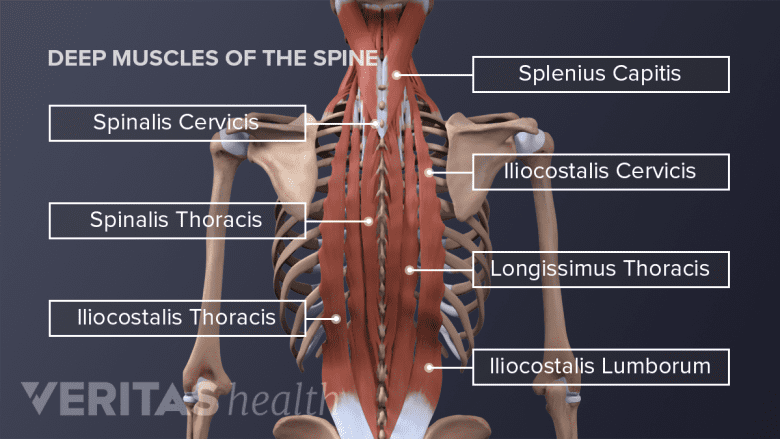
Existe un grupo amplio y complejo de músculos que trabajan en conjunto para sostener la columna vertebral, ayudar a mantener el cuerpo erguido y permitir que el tronco del cuerpo se mueva, gire y doble en muchas direcciones.
Músculos extensores, flexores y oblicuos de la espalda
Los tres tipos principales de músculos de la espalda que ayudan a la columna vertebral a funcionar son los extensores, los flexores y los oblicuos.
- Los músculos extensores están unidos a la parte posterior de la columna vertebral y permiten acciones como estar de pie y levantar objetos. Estos músculos incluyen los grandes músculos pares de la espalda baja, llamados erector de la columna, que ayudan a sostener la columna vertebral y los músculos glúteos.
- Los músculos flexores están unidos a la parte frontal de la columna vertebral y permiten inclinarse hacia adelante, levantar objetos y arquear la espalda baja.
- Los músculos oblicuos están unidos a los lados de la columna vertebral y ayudan a rotar la columna y mantener una postura adecuada.
Ver Video: Comprensión de los diferentes tipos de dolor de espalda
El papel de la actividad física y el ejercicio en el mantenimiento de la salud muscular

Fortalecer los músculos de la espalda ayuda a reforzar el soporte de la columna vertebral.
Los músculos de la espalda, como cualquier otro músculo del cuerpo, requieren ejercicio adecuado para mantener la fuerza y el tono.
Si bien la pierna y el muslo se utilizan cada vez que caminamos o subimos un escalón, los músculos profundos de la espalda y los músculos abdominales generalmente no se activan durante las actividades cotidianas. A menos que los músculos se ejerciten específicamente, los músculos de la espalda y los abdominales tienden a debilitarse con la edad.
La fisioterapia y el ejercicio para el dolor de espalda baja generalmente se centran en fortalecer los músculos flexores, extensores y oblicuos. Esto, a su vez, ayuda a reforzar el soporte de la columna vertebral, reduciendo así el dolor lumbar.
Ver Programa de ejercicios sencillos para aliviar el dolor de espalda baja
En Este Artículo:
El papel de los músculos de la espalda en la causa del dolor de espalda
El estrés puede causar que los músculos de la espalda se tensionen, provocando espasmo y dolor.
Cuando las articulaciones facetarias u otras estructuras de la columna vertebral se lesionan o inflaman, los grandes músculos de la espalda pueden sufrir espasmos y causar dolor lumbar y una marcada limitación del movimiento.
Ver Video: ¿Qué le dice el espasmo muscular de la espalda?
Un episodio de dolor de espalda baja que dura más de dos semanas puede provocar debilidad muscular (ya que usar los músculos duele, la tendencia es evitar usarlos). Este proceso conduce a la atrofia muscular y al debilitamiento posterior, lo que a su vez causa más dolor de espalda porque los músculos de la espalda son menos capaces de sostener la columna vertebral.
El estrés crónico también puede provocar debilidad muscular y dolor de espalda. El estrés hace que los músculos de la espalda se tensen en una respuesta de lucha o huida, privando a los músculos de la energía necesaria para sostener la columna vertebral.
Otra estructura clave en el dolor de espalda baja son los músculos isquiotibiales, los grandes músculos en la parte posterior de los muslos. Los pacientes con isquiotibiales tensos tienden a desarrollar dolor de espalda baja, y aquellos con dolor de espalda baja tienden a desarrollar isquiotibiales tensos.
Ver Estiramientos específicos de isquiotibiales para aliviar el dolor de espalda
La fuerza y la flexibilidad muscular son esenciales para mantener la posición neutra de la columna vertebral. Los músculos abdominales débiles hacen que los músculos flexores de la cadera se tensionen, causando un aumento de la curvatura de la espalda baja.
Una postura inadecuada resulta cuando la curva se sobreextiende, lo que se denomina lordosis o hiperlordosis. La postura correcta corrige los desequilibrios musculares que pueden provocar dolor lumbar al distribuir el peso de manera uniforme por toda la columna vertebral.
