
Subscribe to our newsletter and get your FREE guide,
Natural Back Pain Relief: 16 Choices for Lasting Comfort.
Pilates is an effective exercise program for reducing back pain and tightness. It helps the spine through several methods:
Neutral Spine Alignment – Learning proper posture to reduce strain on the spine.
Deep Core Strength – Strengthening the deep muscles of the back and abdomen to provide much needed spinal support.
Improved Flexibility – Enhancing muscle length and suppleness to prevent stiffness, including the hip muscles that support the low back.
Efficient Movement – Using mental focus to improve muscle control and movement efficiency.
Breath Control – Incorporating breathing techniques to aid in focus and relaxation.
Pilates for Lower Back Pain Relief
Individuals with lower back pain find Pilates helps reduce their low back pain by:
- Reducing postural problems that contribute to wear and tear on spinal joints and discs.
- Strengthening deep postural muscles that support neutral spine alignment.
- Enhancing core stability to better support the spine during movement.
- Improves joint strength and flexibility in the hip and shoulder muscles, promoting fluid movement in the major joints and reducing excess strain on the spine.
The above benefits of Pilates tend to be especially helpful for people with spinal motion segment instability associated with disc degeneration, such as at the L4-L5 motion segment and or the lumbosacral segment L5-S1.
advertisement
Developing Healthy Movement Habits
Pilates teaches awareness of movement patterns that may stress the spine. Through practice, individuals learn to:
- Recognize and change habits that compromise spinal alignment and supported posture.
- Reduce excessive muscle tension for more efficient body movement.
This focus on posture, core strength, and movement efficiency helps develop a healthier, less painful spine.
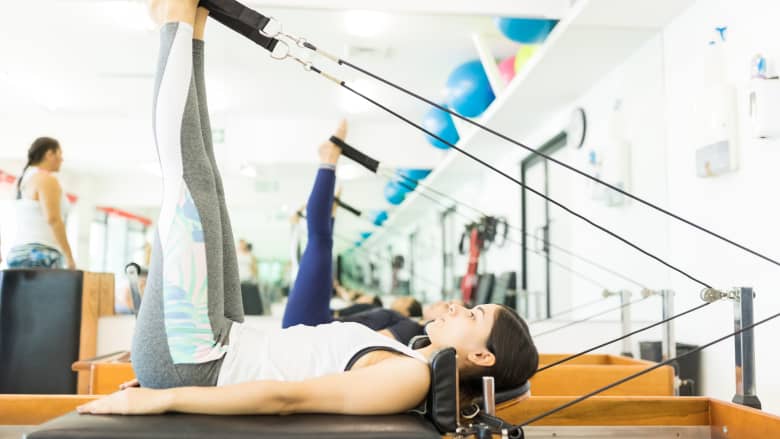
The principle piece of equipment for performing pilates is called the Reformer and consists of a sliding platform anchored at one end of its frame with springs.
The Pilates Exercise Program
The exercise system is usually taught in one of two formats:
- Using the unique Pilates equipment in private, or semi-private, sessions
- Group mat classes not using equipment
In all formats, the principles of movement important for back health are taught in some of the simplest exercises of the Pilates system.
Even for Pilates beginners, one cannot underestimate the benefit of simple exercises that support the deep postural muscles of the trunk, awareness of neutral alignment, and supple use of the shoulders and hips.
advertisement
Pilates Considerations for Back Pain Patients
Several important guidelines for anyone with back pain starting a Pilates program include:
- Before starting any new exercise system, be sure to have an evaluation by a physician or other healthcare provider.
- Check that the Pilates instructor has received training in the Pilates exercise system, and that they understand your specific back problem / diagnosis.
- If you start Pilates after physical therapy, the physical therapist should outline the exercise principles identified as particularly important for your rehabilitation so you can communicate that to the instructor.
- If you have a significant back problem, you may benefit from several one-on-one Pilates sessions with a qualified Pilates instructor.
- Individual instruction is more expensive than a group class or mat class, the time, money, and effort devoted to learning the exercises correctly can be well worth the investment, as exercises performed incorrectly can make a back problem worse.
- Given its roots in ballet and dance, some of the movements in the Pilates system are very difficult and challenging. If you have severe pain from degenerative disc disease or another condition, the instructor will likely have you build up to more challenging exercises.
- If certain exercises cause significant pain even with a graded approach, you may need to avoid that specific exercise.
Initially, twice-a-week sessions tend to be helpful to learn the Pilates program more quickly.
After that, weekly Pilates exercise sessions may be recommended. It is best to learn exercises that can be practiced at home between scheduled Pilates sessions.
As a rule, back patients should be careful with exercises that push the spine into extremes of flexion (bending forward) or extension (bending backward) or combine flexion with side bending or twisting the spine, as these motions place excessive stress on the intervertebral discs. These movements can be safely worked up to with instruction and gradually over time.
See Exercises to Avoid with a Lumbar Herniation
The exercises in the Pilates system should be challenging (both mentally and physically) but not so difficult that they cause anyone to struggle. If an exercise causes pain - it is best to stop and tell the instructor. The exercise may be too difficult, or the person may need additional help to do it correctly.
It is also important to avoid fatigue - either mental or physical - which is when the proper exercise form is lost and injuries are more likely to occur.
advertisement
Final Thoughts
Remember, first see a physician prior to starting any exercise program, as Pilates is not recommended for certain spine conditions, such as instability from advanced spondylolisthesis or spinal fractures.
It may take a while for the full benefits of a Pilates exercise program to be realized. Just as problems that create most back pain happen gradually over time, learning to use your muscles in a way that support - rather than stress - the spine takes time and commitment.
Pilates has merged with other movement techniques, such as yoga, or use of an exercise ball. This promotes creative integration of the Pilates principles into a greater range of exercises in the mat class setting.
As with other forms of graduated, controlled exercise, regular engagement in a Pilates exercise program can potentially lead to secondary benefits such as reduced need for opioid or other pain medications, and potentially help avoid low back surgery.

advertisement