




Subscribe to our newsletter and get your FREE guide,
Natural Back Pain Relief: 16 Choices for Lasting Comfort.
The intense, searing sciatic pain stemming from a herniated disc can be effectively alleviated by a controlled and progressive exercise and rehabilitation program. If the acute pain is too intense to exercise, a pain management intervention, such as medication or a lumbar epidural steroid injection, may be recommended to facilitate progress with the exercise program.
Targeted exercises for sciatica caused by a lumbar herniated disc typically have two main goals, which include:
- Relieving acute, intense sciatic pain
- Providing rehabilitation for longer-term healing
Lumbar herniated disc exercises specifically activate and strengthen the abdominal, deep spinal, gluteal, pelvic floor, and diaphragm muscles.
Exercise and physical therapy for a lumbar herniated disc will largely depend on the length of time the patient has had symptoms and the severity of the pain.
In This Article:
Exercises for Sciatic Nerve Pain Caused by a Herniated Lumbar Disc
There is a wide range of strengthening and stretching exercises that may be prescribed to treat sciatica from a herniated disc. Exercise categories include:
- McKenzie method
- Abdominal and back strengthening exercise
- Abdominal and back stabilization exercise,
- Nerve mobilization exercise
Nerve mobilization helps treat nerves that form adhesions, which are fibrous bands of soft tissue that develop due to inflammation, making them stiff. These adhesions typically develop as a result of a longstanding reduction in blood flow and swelling around the sciatic nerve roots caused by herniated discs. Over time, the adhesions cause painful symptoms to develop from the spinal nerve root area, traveling down the leg as sciatica.
McKenzie Method for Sciatica from a Herniated Disc
The McKenzie method focuses on a process called pain centralization—moving the pain symptoms from the leg or foot to the lower back. Once the pain is moved, the lower back pain can be treated more efficiently through strengthening and stabilizing exercises.
Centralizing lower back pain is accomplished by getting the spine into a backward-bending position or extension.
Watch Video: What Is the McKenzie Method?
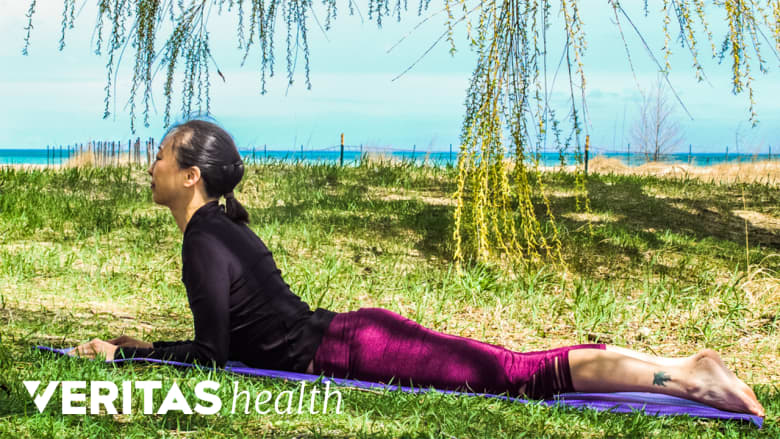
Press-ups
Press-up exercises help alleviate herniated disc pain in the lower back.
This exercise should be started slowly and carefully, since this position may be painful at first.
- Lie on the stomach (prone position) and prop up the upper body on the elbows. Do not lift the hips off the floor.
- Hold the press-up position initially for 5 seconds and gradually work up to 30 seconds per repetition.
Aim to complete 10 repetitions.
advertisement
Advanced extension
Start in the prone position.
- Lie on the stomach with hands under the shoulders and flat on the floor
- Gently press up on both hands.
- Keep the pelvis in contact with the floor.
- Keep the lower back and buttocks relaxed for a gentle stretch.
Hold this position for a few seconds, as tolerable, and repeated 10 times.
If lying flat causes too much pain, a similar exercise can be done standing:
- Place both hands on the hips for support and lean back as far as is comfortable while feeling a stretch in the lower back.
- Be sure not to stretch so far that falling is a risk. Hold this position for 5 seconds, gradually working up to holding for 30.
Repeat the exercise 10 times.
As the pain works out of the leg and centralizes, exercises to strengthen and stabilize the lower back and abdominal muscles are recommended to treat the centralized pain.
See 7 McKenzie Method Exercises for Back Pain and Sciatica
Exercises for Strengthening the Lower Back Muscles
Lower back strengthening and stabilizing exercises include more advanced workouts while lying on the stomach. These exercises increase muscle strength, maintain posture, and prevent excessive movements of the lumbar spine.
Upper back extension
Upper back extension exercise strengthens the extensor muscles of the spine.
This exercise strengthens the extensor muscles of the spine.
- In the prone position, with both hands clasped behind the lower back, gently raise the head and chest slightly while looking at the floor (stay low).
- Begin by holding the position for 5 seconds and gradually work up to 20 seconds.
Aim to complete 8 to 10 repetitions.
Prone arm and leg lifts
This exercise strengthens the back, abdominal, trunk, and hip muscles.
- In the prone position with the head and chest lowered to the floor, slowly raise an arm and the opposite leg, 2 to 3 inches from the floor, without bending the knee.
- Begin by holding the position for 5 seconds.
Complete 8 to 10 repetitions. As strength builds, aim to hold the position for 20 seconds.
See Strengthening Exercise Program for Low Back Pain Relief
Exercises for Strengthening the Abdominal Muscles
Exercises that build abdominal muscle strength and stability are performed while lying on the back.
Curl-ups for upper abdominal muscles
The curl-up exercise primarily focuses on the abdominal muscles.
Start by lying on the back with both knees bent and feet flat on the floor.
- Fold both arms across the chest and tilt the pelvis to flatten the back against the floor.
- Gently lift the head and shoulders off the floor.
- Hold for 2 to 4 seconds and slowly get back to the starting position.
As strength builds, aim to complete 2 sets of 10 curls. Do not attempt to lift the head up too high. If neck pain occurs, place the hands behind the head to support the neck.
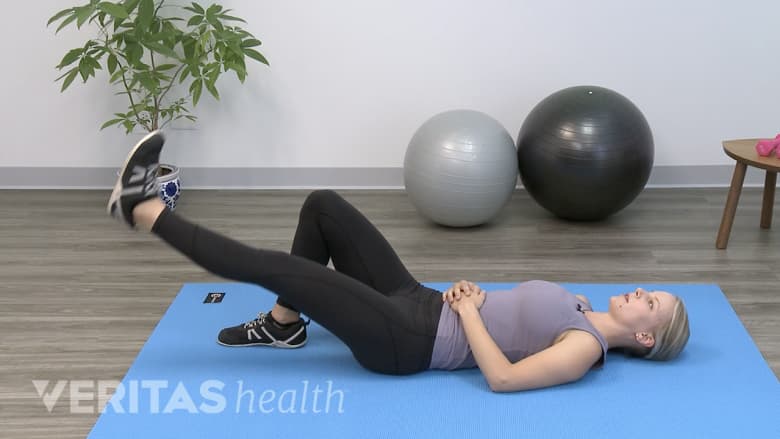
Single leg raises for the lower abdominal muscles
The straight leg raise exercise strengthens the core muscles.
Start by lying on the back and tightening the stomach muscles.
- Slowly raise one leg 8 to 12 inches from the floor, without bending the knee.
- Keep the low back and opposite leg flat against the floor. Hold leg raise for 8 to 10 seconds, then slowly lower to starting position.
As strength builds, aim to complete 2 sets of 10 lifts.
If performing these exercises is painful, water therapy may be considered as an alternate option. The buoyancy water provides support, which in turn minimizes the pain. Water exercises can be particularly beneficial in strengthening the lower abdominal and hip muscles.
advertisement
Sciatic Nerve Glide Exercise
Sciatic nerve glide exercises promote nerve mobility and relieve compression-related symptoms.
Nerve mobilization and glide exercises (nerve stretching) aim to relieve nerve tension and make the nerve more flexible. For sciatic nerve mobilization, follow these steps:
- Sit upright on a chair and lift one leg to straighten the knee, while keeping the other foot flat on the floor.
- Slowly bend the ankle so that the toes are pointing upward.
- Continue to bend the ankle back and forth, pointing the toes upward and outward.
- As tolerated, to put more tension on the sciatic nerve, try the same nerve glide with the head bent forward, bringing the chin towards the chest.
- Pump the ankle up and down 15 to 20 times and then repeat the exercise with the other leg.
Aim to complete 3 rounds for each leg, twice a day.

advertisement