
Subscribe to our newsletter and get your FREE guide,
L5-S1 Symptoms Tracker.
Sciatica is a term used to describe nerve pain in the leg that is caused by irritation and/or compression of a sciatic nerve root.
Sciatica originates in the lower back, radiates deep into the buttock, and travels down the leg. The pain may be accompanied by numbness and/or weakness.
Common Symptoms of Sciatica
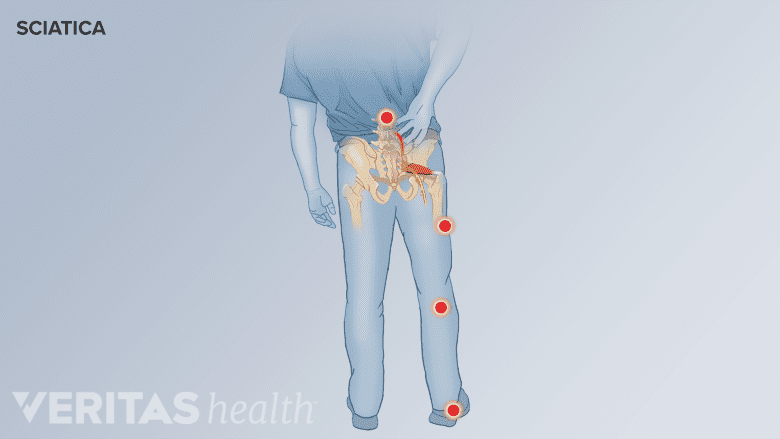
Sciatica symptoms typically affect one side of the body.
The symptoms of sciatica are commonly felt along the path of the large sciatic nerve. Sciatica is often characterized by one or more of the following features:
- Pain. Sciatica pain is typically felt like a constant burning sensation or a shooting pain starting in the lower back or buttock and radiating down the front or back of the thigh and leg and/or feet.
- Numbness. Sciatica pain may be accompanied by numbness in the back of the leg. Sometimes, tingling and/or weakness may also be present.
- One-sided symptoms. Sciatica typically affects one leg. The condition often results in a feeling of heaviness in the affected leg. Rarely, both legs may be affected together.
- Posture induced symptoms. Sciatica symptoms may feel worse while sitting, trying to stand up, bending the spine forward, twisting the spine, lying down, and/or while coughing. The symptoms may be relieved by walking or applying a heat pack over the rear pelvic region.
See Understanding Sciatica Symptoms: Pins and Needles, Numbness, Icy, and Burning
It is important to note that any type of lower back pain or radiating leg pain is not sciatica. Sciatica is specific to pain that originates from the sciatic nerve.
advertisement
In This Article:
- What You Need to Know About Sciatica
- Sciatica Symptoms
- Sciatica Causes
- Diagnosing the Cause of Sciatica
- Sciatica Treatment
- Sciatica Surgery
- Sciatica Causes and Symptoms Video
Main Causes of Sciatica

Herniated discs are the most common cause of sciatica.
Sciatica is a term used to describe a set of symptoms caused by an underlying medical condition; it is not a medical diagnosis.
Common medical conditions that may cause sciatica include:
- A herniated lumbar disc
- Lumbar spinal stenosis
- Lumbar degenerative disc disease, general degenerative changes in vertebrae or discs
- Spondylolisthesis
- Muscle spasm and/or inflammation of the lumbar and/or pelvic muscles
- Sacroiliac joint dysfunction
Rarely, tumors, blood clots, or other conditions in the lower spine may cause sciatica.
Read more about Sciatica Causes
In addition to the terms that identify the underlying pathologies that cause sciatica, the terms lumbar radiculopathy or radicular pain may be used interchangeably with the term sciatica.
The Sciatic Nerve and Sciatica
The sciatic nerve is the largest single nerve in the body and is formed by the union of 5 nerve roots in the lumbar and sacral spine. There are 2 sciatic nerves in the body—the right and left nerves, supplying the corresponding lower limb.
A few anatomical characteristics of the sciatic nerve include:
- Origin. Starting at the level of the spinal segment L4, the sciatic nerve is formed by the merging of spinal nerves roots from L4 to S3. The emerging nerve roots converge into a single sciatic nerve making it large and bulky, typically up to 2cms in diameter.
- Path. After its individual contributions end, the sciatic nerve exits the pelvis through the greater sciatic foramen, below the piriformis muscle. The nerve then runs along the back of the thigh, into the leg, and finally ends in the foot.
- Branches. The sciatic nerve branches into 2 main divisions behind the knee—the tibial nerve and the common peroneal nerve. The tibial nerve courses down and supplies the back of the leg and the sole of the foot. The common peroneal nerve supplies the front of the leg and foot.
Rarely, the sciatic nerve may split into 2 nerves near the sciatic foramen, which merge again into a single nerve.
The specific sciatica symptoms largely depend on the nerve root that is pinched. For example, an L5 nerve impingement can cause pain in the back of the thigh and weakness in lifting the big toe and the ankle.
advertisement
The Course of Sciatica

Progression of bone degeneration in the spine.
Often, a particular event or injury does not cause sciatica—rather it tends to develop over time. Sciatica affects 10% to 40% of the population, typically around the age of 40 years.
Sciatica is found to be common in certain types of occupation where physically strenuous positions are used, such as machine operators or truck drivers. Specifically, people who often bend their spine forward or sideways or raise their arms frequently above the shoulder level may be at risk of sciatica.,
How long does sciatica take to heal?
The vast majority of people who experience sciatica typically get better within 4 to 6 weeks with nonsurgical sciatica treatments. If severe neurological deficits are present, recovery may take longer. An estimated 33% of people, however, may have persistent symptoms up to 1 year.
When severe nerve compression is present with progressive symptoms, surgery may be indicated.
advertisement
When Sciatica Is Serious

Severe damage to the spinal cord or spinal nerves can cause medical emergencies.
Certain symptoms of sciatica may indicate a serious medical condition, such as cauda equina syndrome, infection, or spinal tumors. These symptoms may include, but are not limited to:
- Progressive neurological symptoms, such as leg weakness
- Symptoms in both legs
- Bowel and/or bladder dysfunction
- Sexual dysfunction
It is advised to seek medical attention immediately if such symptoms develop. Sciatica that occurs after an accident or trauma, or if it develops in tandem with other symptoms like fever or loss of appetite, is also cause for prompt medical evaluation.

advertisement