
Subscribe to our newsletter and get your FREE guide,
Natural Back Pain Relief: 16 Choices for Lasting Comfort.
A regular routine of hamstring stretching is an essential part of almost all sciatica treatment programs. Like all physical therapy and exercise, it is important to use the correct form and posture while performing the stretches.
The hamstrings are a group of 3 long, large muscles—the semitendinous, semimembranous, and biceps femoris muscles, located in the back of the thigh.1Shakya N R, Manandhar S. Prevalence of hamstring muscle tightness among undergraduate physiotherapy students of Nepal using passive knee extension angle test. International Journal of Scientific and Research Publications, Vol 8. Published Jan 2018, 182–185. Available from: http://www.ijsrp.org/research-paper-0118.php?rp=P737129 They run from the pelvis down to the knee and help bend the knee and extend the hip. These muscles also control the alignment of the pelvis and spine.2Alshammari F, Alzoghbieh E, Abu Kabar M, Hawamdeh M. A novel approach to improve hamstring flexibility: A single-blinded randomised clinical trial. S Afr J Physiother. 2019;75(1):465. Published 2019 Apr 23. Available from: https://www.ncbi.nlm.nih.gov/pmc/articles/PMC6495003/ Because most daily activities do not stretch the hamstrings, they are often overly tight and specific stretching exercises are needed to keep them healthy and flexible.
Tightness in the hamstring muscles can place increased stress on the lower back,1Shakya N R, Manandhar S. Prevalence of hamstring muscle tightness among undergraduate physiotherapy students of Nepal using passive knee extension angle test. International Journal of Scientific and Research Publications, Vol 8. Published Jan 2018, 182–185. Available from: http://www.ijsrp.org/research-paper-0118.php?rp=P737129 causing or aggravating some of the conditions that lead to back pain and sciatica. Postural changes occur as a result of tight hamstrings, which may result in lower back and leg pain, including hip, knee, and/or ankle pain.2Alshammari F, Alzoghbieh E, Abu Kabar M, Hawamdeh M. A novel approach to improve hamstring flexibility: A single-blinded randomised clinical trial. S Afr J Physiother. 2019;75(1):465. Published 2019 Apr 23. Available from: https://www.ncbi.nlm.nih.gov/pmc/articles/PMC6495003/
Stretching and loosening the hamstring muscles can help relieve sciatic nerve root pressure and improve lower back pain. Hamstring stretches are easy and can be done at home or in office. Depending on the pain and comfort level, stretches can be performed while standing, sitting, or lying down.
In This Article:
- Hamstring Stretching Exercises for Sciatica Pain Relief
- Easy Hamstring Stretches
- Hamstring Exercises for Low Back Pain Relief Video
- Tips for Hamstring Stretching Video
Causes of Tight Hamstrings
The 3 muscles comprising the hamstrings gradually lose their flexibility with age. Tightness begins to develop during early childhood, slowly increasing over time due to a change in elasticity and decreased level of physical activities that involve these muscles.1Shakya N R, Manandhar S. Prevalence of hamstring muscle tightness among undergraduate physiotherapy students of Nepal using passive knee extension angle test. International Journal of Scientific and Research Publications, Vol 8. Published Jan 2018, 182–185. Available from: http://www.ijsrp.org/research-paper-0118.php?rp=P737129
In general, women have more flexible hamstrings than men of the same age, which is likely due to anatomical variations in joint structure and also the performance of more rigorous physical work by men, resulting in greater micro-trauma to these muscles.1Shakya N R, Manandhar S. Prevalence of hamstring muscle tightness among undergraduate physiotherapy students of Nepal using passive knee extension angle test. International Journal of Scientific and Research Publications, Vol 8. Published Jan 2018, 182–185. Available from: http://www.ijsrp.org/research-paper-0118.php?rp=P737129
Routinely participating in high-intensity sports that involve running, sprinting, and abrupt leg movements, such as basketball and tennis, are common risk factors for hamstring tightness. Sports medicine specialists commonly recommend stretching the hamstrings before engaging in such type of sports while counseling athletes on injury prevention.
How Tight Hamstrings Affect the Sciatic Nerve
The hamstring muscles play an important role in supporting the mechanics of spinal movements, especially during flexion (forward bending). When the spine bends forward, loads are distributed evenly between the lower back and the hip to facilitate a smooth bending movement.3Hasebe K, Okubo Y, Kaneoka K, Takada K, Suzuki D, Sairyo K. The effect of dynamic stretching on hamstrings flexibility with respect to the spino-pelvic rhythm. The Journal of Medical Investigation. 2016;63(1.2):85-90. doi:10.2152/jmi.63.85
When the hamstrings are tight, the biomechanics of the lower spine and hip (pelvis) are altered. Over time, the following changes tend to occur:
- The pelvis tilts forward4ee JH, Kim TH. The treatment effect of hamstring stretching and nerve mobilization for patients with radicular lower back pain. J Phys Ther Sci. 2017;29(9):1578–1582. Available from: https://www.ncbi.nlm.nih.gov/pmc/articles/PMC5599824/
- There is an increase in the curvature of the lower spine4ee JH, Kim TH. The treatment effect of hamstring stretching and nerve mobilization for patients with radicular lower back pain. J Phys Ther Sci. 2017;29(9):1578–1582. Available from: https://www.ncbi.nlm.nih.gov/pmc/articles/PMC5599824/
- The mobility and load on the lower spine are increased during forward bending movements3Hasebe K, Okubo Y, Kaneoka K, Takada K, Suzuki D, Sairyo K. The effect of dynamic stretching on hamstrings flexibility with respect to the spino-pelvic rhythm. The Journal of Medical Investigation. 2016;63(1.2):85-90. doi:10.2152/jmi.63.85
Increased spinal loads, abnormal curvature, constant movements, and repetitive stress on the lower back may cause sciatica to occur when the lumbar and/or sacral nerve roots are irritated.
advertisement
How to Identify Tight Hamstrings
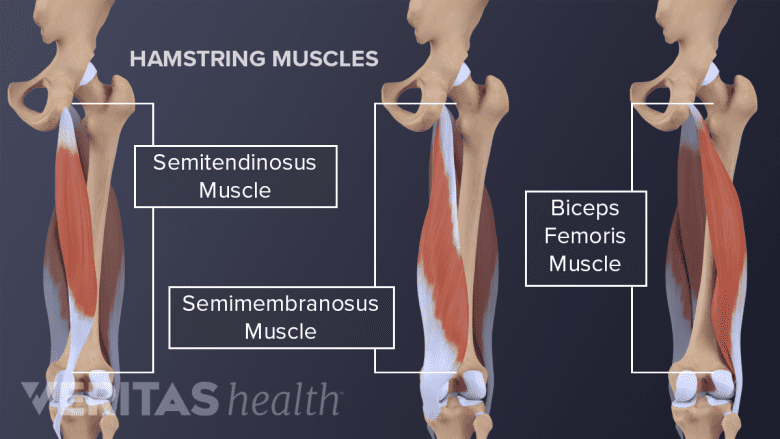
The hamstring muscles bend the knee, extend the hip, and control pelvis and spine alignment.
The hamstring muscles originate in the ischial tuberosity, a rounded bone at the bottom of the pelvis, and inserts into the upper part of the back of the tibia (the larger of the two leg bones). When these muscles contract, they bend (flex) the knee and straighten (extend) the hip.
Stretching the hamstrings would require the knee to be straightened and hip to be bent forward. If this maneuver is painful, it is safe to assume that the hamstring muscles are tight. Tension in these muscles can be assessed by extending the knee in a sitting position.
A quick test to check for tightness in the hamstrings can be done by following these two steps5Kreder HJ, Jerome D. THE HIP. In: Fam’s Musculoskeletal Examination and Joint Injection Techniques. Elsevier; 2010:45-63. doi:10.1016/b978-0-323-06504-7.10005-3:
- While sitting straight on a flat surface with the knees bent and feet flat on the ground, one knee is slowly straightened
- If the hamstrings are tight in the extended leg, the person will lean backward (extend the hip) into a reclining position to reduce tension in the tight hamstring
This posture is also called a tripod sign or flipping sign because the patient usually places their arms behind to support the trunk, creating a tripod.5Kreder HJ, Jerome D. THE HIP. In: Fam’s Musculoskeletal Examination and Joint Injection Techniques. Elsevier; 2010:45-63. doi:10.1016/b978-0-323-06504-7.10005-3
8 Essential Tips to Stretch the Hamstring Muscles
It is important to keep the hamstrings loose and flexible to maintain spinal stability and prevent lower back and leg pain. The following guidelines provide safe and effective tips to include hamstring stretches in everyday activities:
- Warm up. A 10-minute walk will help improve blood flow to the hamstring muscles. Alternatively, placing a heating pad or hot water bottle on the back of the thigh for 15 to 20 mins will warm up the hamstrings.
- Select a comfortable position. The hamstrings can be stretched in a variety of positions. Depending on the specific underlying condition and level of pain, lying down may be preferable and more comfortable. In particular, people with lower back pain or sciatica should choose a position that is tolerable for their back and leg while still giving a gentle stretch.
- Match the stretch to the spinal diagnosis. The type of stretch will also be dictated based on the specific spine diagnosis. For example, if a lumbar herniated disc is diagnosed as the cause of sciatica, any stretches using a forward bending position should be avoided. For a diagnosis of spinal stenosis, exercises that promote forward bending are encouraged.
- Start slow. In the initial stages, start by holding the hamstring stretch for 10 seconds, and gradually increase to 30 seconds.
- Remain steady. When doing any type of hamstring stretches, avoid bouncing, which can trigger a muscle spasm. Instead, enter the stretch gently and hold it.
- Be mindful. Pay attention to your form and perform steady, deep breathing while holding the stretch.
- Stay consistent. Aim to perform the stretches at least twice a day. Many people find it helpful to tie the stretching activity to something else they do twice daily, such as brushing the teeth. If hamstring stretching is only done before exercising, most people will not do it enough.
- Cool down. If there is soreness after the stretching, placing a cold pack on the back of the thigh for 10 to 15 minutes can help cool the muscles and reduce inflammation.
advertisement
As a general guideline, if there is significant pain while stretching, it is advisable to stop the stretch. Nerve pain or an escalation of sciatica symptoms should not be experienced during any stretching exercises. If any pain or increase in sciatica symptoms is experienced, it is advisable to stop the stretches and consult with a physical therapist or spine specialist.
See Physical Therapy and Exercise for Sciatica
If regular hamstring stretching continues to be difficult, the stretching may be done as part of a water therapy program. Warm water in a pool provides both support and gentle resistance, which in turn makes stretching less stressful with little or no pain.
Hamstrings are an important group of thigh muscles that play an essential role in stabilizing the spine during movements such as forward bending.6Jandre Reis FJ, Macedo AR. Influence of Hamstring Tightness in Pelvic, Lumbar and Trunk Range of Motion in Low Back Pain and Asymptomatic Volunteers during Forward Bending. Asian Spine J. 2015;9(4):535–540. Available from: https://www.ncbi.nlm.nih.gov/pmc/articles/PMC4522442/ Since bending movements are common during daily activities, it is essential to keep the hamstrings healthy to prevent injury to the lower back and the sciatic nerve.
- 1 Shakya N R, Manandhar S. Prevalence of hamstring muscle tightness among undergraduate physiotherapy students of Nepal using passive knee extension angle test. International Journal of Scientific and Research Publications, Vol 8. Published Jan 2018, 182–185. Available from: http://www.ijsrp.org/research-paper-0118.php?rp=P737129
- 2 Alshammari F, Alzoghbieh E, Abu Kabar M, Hawamdeh M. A novel approach to improve hamstring flexibility: A single-blinded randomised clinical trial. S Afr J Physiother. 2019;75(1):465. Published 2019 Apr 23. Available from: https://www.ncbi.nlm.nih.gov/pmc/articles/PMC6495003/
- 3 Hasebe K, Okubo Y, Kaneoka K, Takada K, Suzuki D, Sairyo K. The effect of dynamic stretching on hamstrings flexibility with respect to the spino-pelvic rhythm. The Journal of Medical Investigation. 2016;63(1.2):85-90. doi:10.2152/jmi.63.85
- 4 ee JH, Kim TH. The treatment effect of hamstring stretching and nerve mobilization for patients with radicular lower back pain. J Phys Ther Sci. 2017;29(9):1578–1582. Available from: https://www.ncbi.nlm.nih.gov/pmc/articles/PMC5599824/
- 5 Kreder HJ, Jerome D. THE HIP. In: Fam’s Musculoskeletal Examination and Joint Injection Techniques. Elsevier; 2010:45-63. doi:10.1016/b978-0-323-06504-7.10005-3
- 6 Jandre Reis FJ, Macedo AR. Influence of Hamstring Tightness in Pelvic, Lumbar and Trunk Range of Motion in Low Back Pain and Asymptomatic Volunteers during Forward Bending. Asian Spine J. 2015;9(4):535–540. Available from: https://www.ncbi.nlm.nih.gov/pmc/articles/PMC4522442/

advertisement