Spinal anatomy is a remarkable combination of strong bones, flexible ligaments and tendons, large muscles, and highly sensitive nerves. It is designed to be incredibly strong, protecting the highly sensitive nerve roots, yet highly flexible, providing for mobility on many different planes.
Most of us take this juxtaposition of strength, structure and flexibility for granted in our everyday lives—until something goes wrong. Once we have back pain, we're driven to know what's wrong and what it will take to relieve the pain and prevent a recurrence.
In This Article:
Typical Anatomical Problems that Cause Back Pain

Spinal pain can arise from problems in the bones, nerves, or other soft tissues.
Many of the intricate structures in the spine can lead to pain, and pain can be concentrated in the neck or back area, radiate to the extremities, or be referred to other parts of the body. For example:
- The large nerve roots that go to the legs and arms may become irritated or pinched
- The smaller nerves that innervate the spine may be irritated due to inflammation or degeneration
- The large paired back muscles (erector spinae) may be strained due to overuse or an injury
- The bones, ligaments or joints themselves may be injured
- The disc space in between the vertebrae may become painful
- Any of the various joint complexes in the spine may degenerate and lead to pain
For anyone with a spine condition, understanding spinal anatomy is a good way to better inform and evaluate diagnostic and treatment options.
Cervical, Thoracic, Lumbar and Sacral Spinal Anatomy
There are four major regions of the spine:
-
The cervical spine (neck)
The neck supports the weight of the head and protects the nerves that run from the brain to the rest of the body. This section of the spine has seven vertebral bodies (bones) that get smaller as they get closer to the base of the skull.
Most neck pain is caused by a muscle, ligament or tendon strain or sprain, and will usually heal with time and non-surgical treatments, such as ice and/or heat, medications, physical therapy, and more.
See Neck Strain: Causes and Remedies
With neck pain that lasts longer than two weeks to three months, or with mainly arm pain, numbness or tingling, there is often a specific anatomic problem. For example, pain that radiates down the arm, and possibly into the hands and fingers, is usually caused by a cervical herniated disc or foraminal stenosis pinching a nerve in the neck.
-
The thoracic spine (upper back)
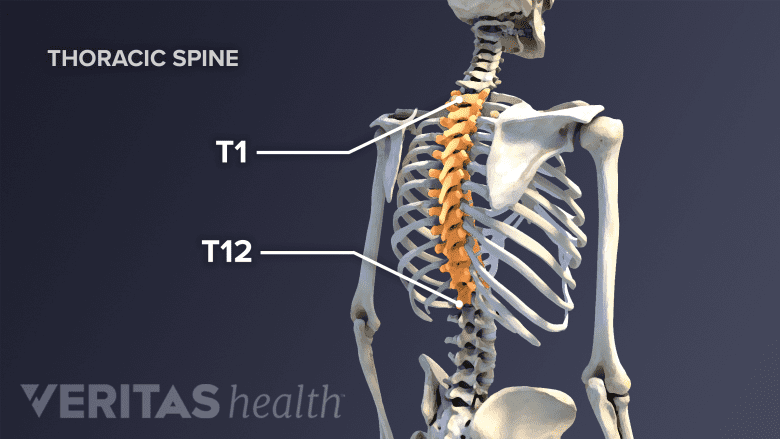
The thoracic spine contains 12 vertebrae.
-
The 12 vertebral bodies in the upper back make up the thoracic spine. The firm attachment of the rib cage at each level of the thoracic spine provides stability and structural support to the upper back and allows very little motion. The thoracic spine is basically a strong cage and it is designed to protect the vital organs of the heart and lungs.
The upper back is not designed for motion, so there is not much wear and tear or injury in this region of the spine. However, irritation of the large back and shoulder muscles or joint dysfunction in the upper back can produce very noticeable back pain. While less common, other issues such as a thoracic herniated disc are also possible.
-
The lumbar spine (lower back)

The lumbar spine carries the weight of the upper body.
The lower back has a lot more motion than the thoracic spine and carries the weight of the torso, which makes it more prone to injury
The motion in the lumbar spine is divided between five motion segments.
Most of the motion in the lumbar spine is at L3-L4 and L4-L5, so these segments are the most likely to breakdown from wear and tear—such as osteoarthritis or degenerative disc disease.
The two lowest discs (L4-L5 and L5-S1) take the most strain and are the most likely to herniate. This can cause lower back pain and possibly numbness that radiates through the leg and down to the foot (sciatica).
The vast majority of episodes of lower back pain are caused by muscle strain. While a muscle strain doesn't sound like a serious injury, it can lead to issues in the lower back can cause severe pain. The good news is that soft tissues have a good blood supply, which brings nutrients to the injured area, facilitates the healing process and often provides effective relief of the back pain.
The sacral region (bottom of the spine)

The sacrum is a triangular-shaped bone at the base of the spine.
Below the lumbar spine is a bone called the sacrum, which makes up the back part of the pelvis. This bone is shaped like a triangle that fits between the two halves of the pelvis, connecting the spine to the lower half of the body.
The sacrum is connected to part of the pelvis (the iliac bones) by the sacroiliac joints. Pain in the sacrum is often called sacroiliac joint dysfunction, and is more common in women than men.
The coccyx—or the tailbone—is in the sacral region at the very bottom of the spine. Tailbone pain is called coccydynia, which is more common in women than men.