The sacral region (sacrum) is at the bottom of the spine and lies between the fifth segment of the lumbar spine (L5) and the coccyx (tailbone).
The sacrum is a triangular-shaped bone and consists of five segments (S1-S5) that are fused together.
In This Article:
Understanding the Sacral Region: Structure, Function, and Common Issues
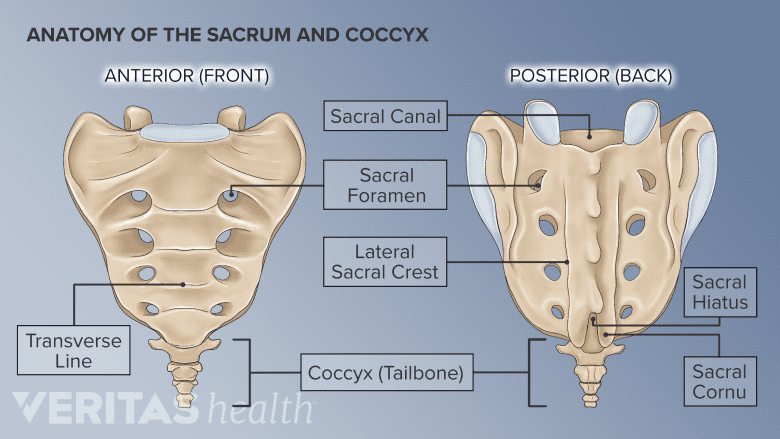
The sacrum and coccyx complete the lower spine and help provide stability and function to the lower back and legs.
- The first three vertebrae in the sacral region have transverse processes that come together to form wide lateral wings called alae. These alae articulate with the blades of the pelvis (ilium).
- As part of the pelvic girdle, the sacrum forms the back wall of the pelvis and also forms joints at the hip bone called the sacroiliac joints.
- The sacrum contains a series of four openings on each side through which the sacral nerves and blood vessels run.
- The sacral canal runs down the center of the sacrum and represents the end of the vertebral canal.
A healthy sacral region is rarely fractured except in instances of serious injury, such as a fall or trauma to the area. However, patients with osteoporosis or rheumatoid arthritis are inclined to develop stress fractures and fatigue fractures in the sacrum.
Back pain or leg pain (sciatica) can typically arise due to injury where the lumbar spine and sacral region connect (at L5-S1) because this section of the spine is subjected to a large amount of stress and twisting during certain activities, such as sports and sitting for long periods of time.
Sacroiliac Joint Dysfunction: Causes and Symptoms
Sacroiliac joint dysfunction is a condition in which pain originates at the SI joint and typically concentrates on one side of the low back. The pain may radiate down the leg to the knee or at times, to the ankle or foot.
The sacrum is typically wider and shorter in women than in men. Due to this reason, young and middle age women are more susceptible to developing sacroiliac joint dysfunction compared to men.
While the exact root of the pain is difficult to pinpoint, disruption of the normal joint motion between the sacrum and ilium is a likely source of pain arising from either:
- Hypermobility (too much movement in the sacroiliac joint)
- Hypomobility (too little movement in the sacroiliac joint)
Watch Sacroiliac Joint Dysfunction Video
Sacroiliac joint dysfunction is also difficult to accurately diagnose since the pain symptoms resemble those associated with a herniated disc and sciatica.
Structure and Function of the Coccyx (Tailbone)
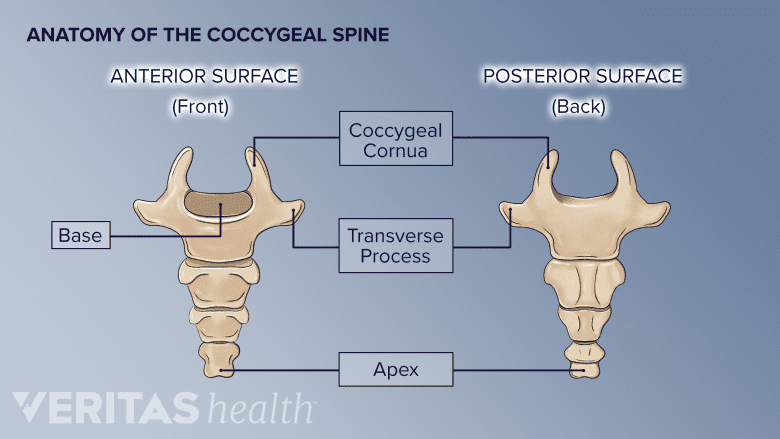
The coccyx is located at the very end of the spine and consists of approximately 4 fused vertebrae.
The coccyx (also called the tailbone) is located at the base of the spine and is composed of around four vertebrae. Unlike the individual vertebrae in other regions of the spine, the vertebrae in the sacral region as well as the coccyx are fused.
Ligaments attach the coccyx to the sacral hiatus at the synovial sacro-coccygeal joint.
See Soft Tissues and Essential Functions of the Coccyx
When sitting, the coccyx shifts forward and acts as a shock absorber. However, falling on the tailbone or events such as childbirth can lead to coccygeal pain, known as coccydynia. In most cases, the pain is caused by an unstable coccyx, which results in chronic inflammation of the sacro-coccygeal joint.
Coccydynia (tailbone pain) can also be attributed to a malformed or dislocated coccyx and the growth of bony spurs on the coccyx. Women are more likely to experience coccydynia, since the coccyx is rotated and faces backward in women, which makes it more susceptible to trauma.