
Subscribe to our newsletter and get your FREE guide,
Natural Back Pain Relief: 16 Choices for Lasting Comfort.
If scoliosis starts to cause a noticeable deformity or is at high risk of doing so, a doctor might prescribe a brace to prevent the curve from getting any worse. Typically, a brace is worn until the adolescent has reached full skeletal maturity.
Knowing if a person’s scoliosis curve is likely to worsen is crucial to developing a treatment plan. Bracing is a major time commitment and uncomfortable for adolescents—both physically and emotionally—and is usually not prescribed unless the curve is at significant risk for progressing.
In This Article:
Risk Factors for Scoliosis to Progress
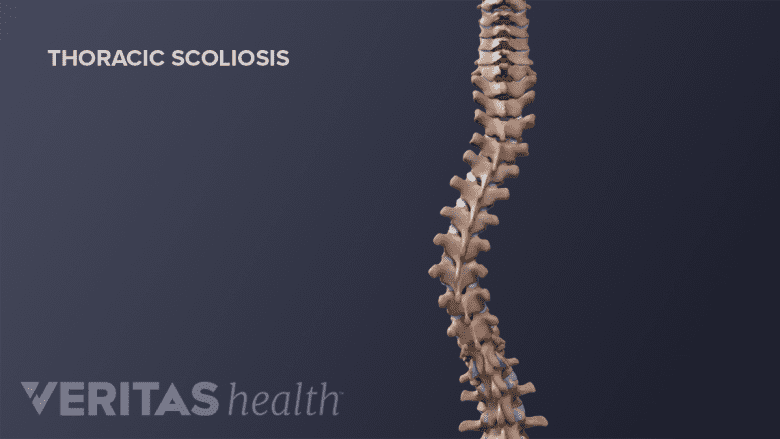
Thoracic scoliosis is more likely to progress than lumbar scoliosis.
In general, the following factors increase a person’s risk for a scoliosis curve to worsen:
- Large lateral curve. In general, the larger the curve’s Cobb angle, the more likely it will progress. For example, if two adolescents with scoliosis have the same amount of skeletal growth remaining but one has a 20-degree curve and the other already has a 30-degree curve, the person with the larger curve is likely to experience more curve progression in the future.
- Significant skeletal growth remaining. If scoliosis has been identified and the adolescent has some skeletal growth left, there is potential for the spine’s lateral curve(s) to grow and worsen. The more skeletal growth remaining, the greater the risk for curve progression.
- Female sex. While boys and girls are about as likely to have mild scoliosis, girls are more than 7 times as likely to have their spinal curves progress to moderate or severe scoliosis and require treatment.
- Curve in thoracic spine. A scoliosis curve located in the upper back is more likely to progress than a curve located lower in the back.
See Thoracic Kyphosis: Forward Curvature of the Upper Back
Once the risk factors for idiopathic scoliosis progression are assessed, treatment decisions can be made.
advertisement
Choosing Observation vs. Bracing
About 90% of idiopathic scoliosis cases are mild and only require observation. Typically, observation is done by a doctor every 4 to 6 months until the adolescent has reached full skeletal maturity.
However, a brace for scoliosis will generally be considered if either of the following occurs to the curve’s Cobb angle:
- Progresses past 25 or 30 degrees with significant skeletal growth remaining
- Progresses at least 5 degrees during any 4- to 6-month period
See Cobb Angle Measurement and Treatment Guidelines
If the curve has become big or is progressing rapidly, the next step is usually bracing treatment in an effort to stop the curve’s progression.
advertisement
Brace Options

A Boston brace is sometimes used for scoliosis treatment.
There are two general treatment options for scoliosis bracing:
- Full-time bracing. These braces are designed to be worn 16 to 23 hours a day. The goal is to wear them all the time with exceptions for bathing, skin care, and exercising.
- Nighttime bracing. These braces use hyper-corrective forces (which put the body out of normal balance and cannot realistically be applied while a person is standing and/or performing daily activities) and are to be worn at least 8 hours a night.
Choosing between full-time bracing and nighttime bracing can depend on size and location of curves, as well as what the patient is willing to do. Some studies have found that nighttime bracing tends to be more effective because patients are more likely to wear a brace at night as prescribed, but other studies have found that full-time bracing—when adhered to as directed—could work even better.
See Controversy Over Whether Bracing Works
There is no current consensus in the medical community regarding whether full-time or nighttime bracing works better than the other. For curves that are less than 35 degrees, recommendations tend to be for either nighttime or full-time bracing as appropriate. For curves that are at least 35 degrees, recommendations tend to be for full-time bracing.
Other Nonsurgical Treatments Unproven
While some people claim that treatments such as physical therapy and manual manipulation can help stop the progression of scoliosis, there is little scientific evidence to support these claims. Bracing is currently the only nonsurgical treatment that has been proven to reduce the natural progression of idiopathic scoliosis curves.
However, if given the okay by a doctor, exercise is healthy for people with scoliosis and helps keep the back strong and flexible.
When Bracing Fails
Sometimes an idiopathic scoliosis curve continues to progress despite bracing. If this happens and the curve progresses past 40 or 50 degrees, spinal fusion surgery may be considered.

advertisement