Herniated Disc

What's a herniated disc, pinched nerve, bulging disc...?

By: Peter F. Ullrich, Jr., MD
January 10, 2007

There are many different terms used to describe spinal disc pathology and associated pain, such as “herniated disc”, “pinched nerve”, and “bulging disc”, and all are used differently by individual healthcare practitioners. Unfortunately, there is no agreement in the healthcare field as to the precise definition of any of these terms. Often the patient hears his or her diagnosis referred to in different terms by different practitioners and is left wondering if there is any consensus on what is wrong.

Practical point Individuals’ symptoms of disc degeneration, and their relief from treatments, can vary tremendously, so patients should provide as complete and accurate account of their symptoms as possible to their practitioner so treatment can be customized for them.

Some examples of terms used to describe spinal disc abnormalities include:

  • Pinched nerve
  • Sciatica
  • Herniated disc (or herniated disk)
  • Bulging disc
  • Ruptured disc
  • Torn disc (or disc tear)
  • Slipped disc
  • Collapsed disc
  • Disc protrusion or degeneration
  • Degenerative disc disease
  • Disc disease
  • Black disc

Rather than try to reconcile the terminology used to refer to spinal anatomy or conditions, it's generally more useful for patients to gain a clear understanding of the precise medical diagnosis, which identifies the actual source of the patient’s low back pain, leg pain, or other symptoms.

Article continues below

The medical diagnosis

A physician’s medical diagnosis (also called “clinical diagnosis”) focuses on determining the source of a patient’s pain. For this reason, the medical diagnosis of a patient’s low back pain, leg pain, or other symptoms is based on more than just the findings from a diagnostic test, such as an MRI scan or CT scan. Instead, the spine care professional arrives at a clinical diagnosis of the cause of the patient’s pain by synthesizing findings from a thorough review of the patient’s medical history, a complete physical exam, and, if appropriate, the results of one or more diagnostic tests.
  • Medical history. The physician will take the patient’s medical history, such as a description of when the low back pain, sciatica or other symptoms occur, a description of how the pain feels, and what activities, positions or treatments make the pain feel better, and more.

  • Physical exam. The physician will conduct a thorough physical exam of the patient, such as testing nerve function and muscle strength in certain parts of the leg or arm, testing for pain in certain positions, and more. Usually, this series of physical tests will give the spine professional a good idea of the type of back problem or neck problem that the patient has.

  • Diagnostic tests. After the physician has a good idea of the source of the patient’s pain, a diagnostic test, such as a CT scan or an MRI scan, is often ordered to confirm the presence of an anatomical lesion in the spine. The tests can give a detailed picture of the problem, such as the location of the herniated disc and impinged nerve roots. Some practitioners advocate more extensive diagnostic tests and will recommend a discogram in order to develop as much information as possible about the patient’s condition. However, this test is expensive and somewhat painful because it is a ‘provocative’ test (i.e., it is designed to provoke pain responses in the patient to locate the area of pain generation).

For these reasons, many doctors will refrain from using discography unless necessary. Although the anatomic findings on an imaging study bear certain significance, they are not in and of themselves diagnostic. There can be lesions present on an imaging study that are not symptomatic. And while it may be troubling for a patient to have the knowledge that their disc health is compromised, most people will have some level of disc degeneration by the time they reach 60 years of age. A patient’s physical exam findings and symptoms need to match the anatomic findings to arrive at an accurate medical diagnosis and, more importantly, an effective treatment plan.

Medical diagnosis determines the pain generator

The key factor in the clinical diagnosis is to determine if the patient has a pinched nerve or if the disc space itself is generating the pain. These two common conditions produce a different type of pain.
  • Pinched nerve: When a patient has a symptomatic herniated disc, it is not the disc space itself that hurts, but rather the disc herniation is pinching a nerve in the spine. This produces pain that is called radicular pain (e.g., nerve root pain, or sciatica from a lumbar herniated disc, or arm pain from a cervical herniated disc).

On Spine-health.com, this type of condition is referred to as a herniated disc.

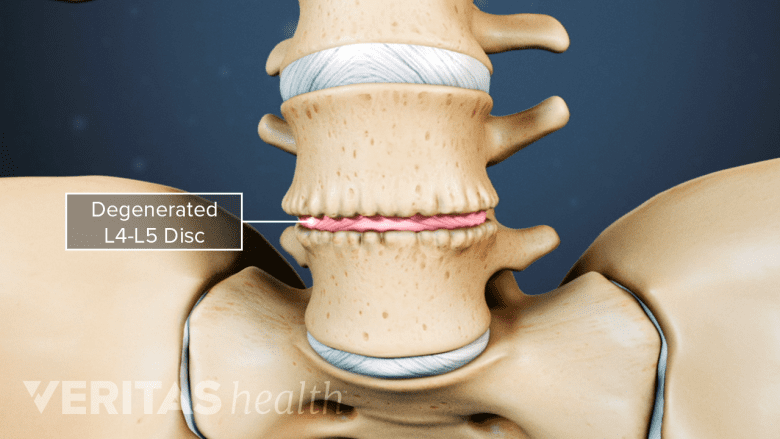
  • Disc pain: When a patient has a symptomatic degenerated disc (one that causes low back pain or other symptoms), it is the disc space itself that is painful and is the source of pain. This type of pain is typically called axial pain.

On Spine-health.com, this type of condition is referred to as a degenerative disc disease.

It should be kept in mind that all the terms – herniated disc, pinched nerve, bulging disc, slipped disc, ruptured disc, etc.– refer to radiographic findings seen on a CT scan or MRI scan (x-rays can indicate disc degeneration but cannot actually image the disc itself). While radiographic findings are important, they are not as meaningful in determining the source of the pain (the clinical diagnosis) as the patient's specific symptoms and the spine specialist's findings on physical exam.

Pinched nerve pain and disc space pain treatments differ

It's critical to accurately diagnose the pain generator, because the type of pain created by the spinal disc dictates the type of treatment, and the treatments for the different diagnoses vary considerably.

For example, treating a lumbar herniated disc will not do the patient much good if it is a muscle strain or other soft tissue injury rather than the disc herniation that is the cause of the patient’s pain. This is particularly important for patients who might be considering surgery. Surgical intervention can only treat anatomic anomalies that have been shown to generate pain; surgery is not appropriate in cases where disc degeneration—even severe disc degeneration – may not be the cause of a patient’s pain, or in situations where the patient has chronic pain but the exact source cannot be adequately identified.

For more information and treatment options on a pinched nerve that causes radicular pain, see articles on herniated disc or disc herniation (the chosen terminology on Spine-health.com), such as:

For more information and treatment options for disc space pain, see articles on degenerative disc disease, such as:


Peter F. Ullrich, Jr., MD
January 10, 2007


advertisement
Featured Video: Degenerative Disc Disease
Did You Know...
Aerobically fit patients will generally have fewer episodes of low back pain, and will experience less pain when an episode occurs. See Back exercise for pain relief

See also:
advertisement